
Wild Future Lab
Material research · Making · Speculative design
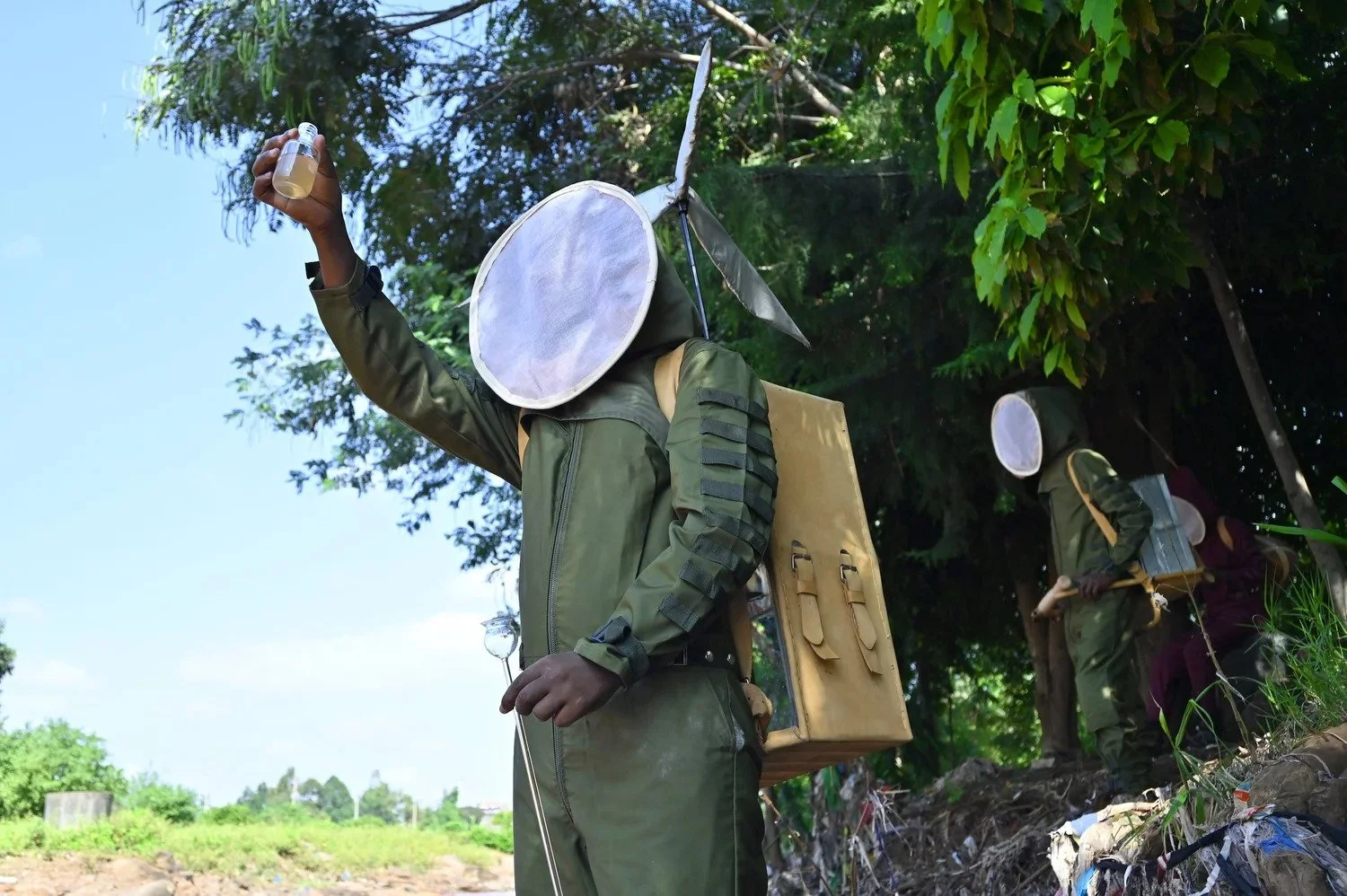
Photograph: a speculative wearable from the Wild Future Lab. Courtesy Kairos Futura.
Materials, machines and possible worlds
Kenya · Research and production, 2025–2026
The Wild Future Lab asks what people could make with the resources, skills and technologies around them. Garments, tools and material samples become evidence from an imagined future—and practical experiments in the present.
The future quest
The Lab’s Nairobi 2045 scenario imagines a city organised around ecological regeneration and local production. What would its people wear? How would they turn plants into thread, repair equipment and make useful objects? Those questions led to work with plant fibres, repurposed textiles, electronics and accessible fabrication tools.
Team involved
Artists, designers, textile makers and technical collaborators develop the work together. The 2025 project credits include Ajax Axe, Abdul Rop, Coltrane McDowell, Willy Ng’ang’a and Helen Milne, alongside participating designers and specialist partners. These are credits for that collaboration.
The investigation process
A fibre has to be grown or collected, separated, cleaned, softened, spun and worked into something people can use. Each stage changes what is possible. The Lab tested banana, flax, nettle, pineapple, water hyacinth and seaweed or algae routes, considering the labour, equipment, consistency and durability each required.
Banana-fibre work with Zaida Crafts explored enzyme treatment and mechanical processing. Flax experiments developed towards linen, with tools for breaking and preparing the fibre and electric spinning equipment. Fabrication research included electronics, pinning machines and open-source CNC components made using 3D printing.
Work produced
Handloom cotton, flax and experimental linen, softened banana fibre, repurposed billboard fabrics and solar-charging garments formed part of the 2026 body of work. Tools and equipment were developed alongside the objects, so the research could consider how a material is actually processed rather than only how a finished piece looks.
The garments and speculative equipment give physical form to the worlds being imagined. Their materials carry questions about labour, access, land use and what a more locally grounded production system would require.
What worked—and what changed
Flax emerged as a promising route for further linen development. Banana-fibre processing required attention to softness and workability. Other material routes were set aside when processing demands, durability or the scale of production made them less useful for the next stage.
These decisions are part of the work. An interesting raw material does not automatically become a dependable textile. A prototype also needs testing, repair and refinement before it can be described as a practical system.
Realized visions
The Wild Future Lab received the 2025 S+T+ARTS Prize Africa Grand Prize. In April 2026, Kairos Futura presented further work during BASE Milano’s We Will Design programme. The research continues through making and through its connections with Safari Studio.
Field programmes supply observations, materials and questions. The Lab provides the equipment, experimentation and practical skills that help an imagined world take physical form.
Credits and partners
Concept and design: Kairos Futura. Textile collaborators include Tosheka Textiles and Zaida Crafts. The 2025 award record credits New Order of Fashion and Lea Oneko among the facilitators, with support from Stimuleringsfonds Creatieve Industrie. Individual design, technical and photography credits remain with the respective works.
Read the official 2025 Grand Prize record and full credits · Explore the existing Lab page · Research and collaboration enquiries